One-night gala or private dinner
Fresh, throughout.
Guests sit within arm's reach for hours, and scent and movement are half the experience. Hold time is not a problem at 12 hours.
Materials guide
Use fresh where cameras get within six feet and the event is under 24 hours. Use high-grade faux for multi-day holds, outdoor heat, high ceilings and anything reusable. On a single event faux costs 20 to 35 percent less than fresh; across three uses of the same piece, 60 to 75 percent less.
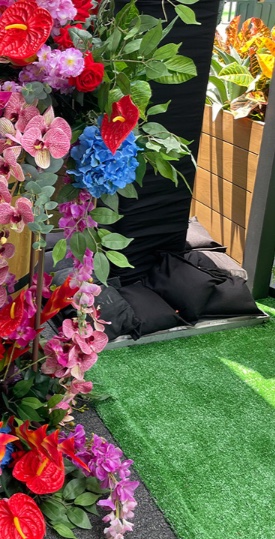
We build both, often inside the same piece, and the decision comes down to four measurable things: hold time, camera distance, climate and reuse. Everything else is preference dressed up as principle.
What follows is the same comparison we run internally before specifying a build — the numbers, the failure modes, and where each material actually earns its place.
For a complete freestanding botanical build, see our custom artificial trees, available to buy or rent with fire-retardant certification and UV-rated outdoor options.
Side by side
| Fresh | High-grade faux | Preserved | |
|---|---|---|---|
| How long it holds | 8–36 hours indoors; less outdoors in Miami heat | Indefinitely, indoors or out | Months to a year without water |
| Cost, single event | Baseline | 20–35% less than fresh | Similar to or above fresh |
| Cost across three uses | Three times the baseline | 60–75% less than fresh | 40–60% less than fresh |
| Close-up realism | Unmatched inside six feet | Indistinguishable beyond six feet | Reads as real at arm's length |
| Heat and sun tolerance | Poor for delicate stems; good for orchid, anthurium, protea | Excellent; colour can fade in permanent direct sun | Good indoors; not for direct sun or damp |
| Weight and rigging load | Heavier — hydration mechanics add water weight | Lightest, easiest to rig overhead | Light, but fragile in transit |
| Scent and movement | Yes — the reason fresh still wins a room | None | None |
| End of life | Composted or re-homed after strike | Stripped and rebuilt into the next piece | Retired when it dusts or fades |
| Best fit | One-night galas, dinners, close-contact hero moments | Multi-day shows, outdoor heat, high ceilings, reusable builds | Permanent lobby, retail and restaurant architecture |
Prices in that table are relative to the fresh version of the same design at the same scale. For the absolute figures, see what a floral installation costs.
Under 24 hours indoors, fresh is safe and it is the better-looking answer. Past 48 hours, fresh needs hydration mechanics, a refresh crew, or both — and at that point the cost of keeping it alive usually exceeds the cost of specifying long-life material for the mass of the piece.
Six feet is the honest line. Inside it, fresh reads visibly better — translucency in a petal is not something faux reproduces. Beyond it, and in every photograph taken past that distance, high-grade faux is indistinguishable. Ceilings, upper wall runs and stage framing are almost always beyond six feet.
A Miami rooftop in July is 90°F with direct sun. Hydrangea will collapse in under three hours out there; orchid, anthurium and protea hold. Conditioned ballroom, no problem. Unconditioned warehouse in August, treat it as outdoor.
This is the question that changes the arithmetic completely. A wall used three times amortizes a faux build down to roughly a quarter of the fresh cost per event. If you run a recurring activation, a seasonal storefront or a monthly program, reuse is where the budget is actually won.
What we actually build
Most of our strongest installations are mixed. Long-life material carries the structure and the mass — the parts that have to survive rigging, heat and four days of an exhibit hall — and fresh florals are placed exactly where guests get close: the entry threshold, the bar face, the table edge, the first two feet of a photo wall.
Honestly priced, a hybrid usually lands 10 to 25 percent below the all-fresh version of the same design on a single event, and further below it every time the structure comes back out of the workshop. It also removes the failure mode nobody plans for: the piece looking tired at hour thirty of a thirty-six hour event.
The trade is real and we will name it. A hybrid has less scent and less movement than an all-fresh build. If your event is one night, indoors, and guests are close the whole time, spend on fresh and enjoy it.
By scenario
Fresh, throughout.
Guests sit within arm's reach for hours, and scent and movement are half the experience. Hold time is not a problem at 12 hours.
Faux for the mass, fresh at the touchpoints.
Four days of exhibit hall lighting and no water access. Long-life material carries the build; a small fresh refresh keeps the front edge alive.
Faux, or heat-tolerant fresh only.
Direct sun and 90°F kill delicate stems within hours. If the brief demands fresh, we specify orchid, anthurium and protea and plan a refresh.
Fresh on the tables, long-life in the architecture.
The pieces guests touch change weekly; the structural florals overhead stay and get restyled seasonally. That split is what keeps a program near $1,200 a month instead of triple it.
Preserved, with fresh accents.
Guests pass within arm's reach every day, so the material has to read real up close — but nobody is watering a two-storey lobby installation twice a week.
Faux, built to be rebuilt.
A structure that tours or repeats pays for itself on the second outing and is close to free on the fourth. This is the strongest financial case for faux there is.
Not on day one. On a single event a high-grade faux build runs about 20 to 35 percent less than the fresh version of the same design. The real saving arrives on reuse: across three uses of the same piece, faux lands 60 to 75 percent below buying fresh three times.
Inside about six feet, yes — fresh wins on translucency, movement and scent, and no amount of money closes that gap. Beyond six feet, and in photographs, high-grade faux is effectively indistinguishable. That distance rule is how we decide where to spend.
Indoors and conditioned, 24 to 36 hours reliably. Outdoors in July at 90°F with direct sun, delicate stems like hydrangea can collapse in under three hours, while orchid, anthurium and protea hold through the day. Outdoor daytime installs are where we push hardest toward faux or a hybrid.
Preserved florals are real stems stabilized so they hold their form for months without water. They cost more per stem than faux but read as real up close, which makes them the right answer for permanent lobby and retail installations where guests pass within arm's reach every day.
Most of our best-performing installations are hybrids. The structure and the mass of the piece are built in long-life material so it holds, and fresh florals are placed where people actually get close — entry thresholds, bar faces, table level. You pay for freshness where it is seen and not where it is not.
Fresh work is composted or, when the timing allows, re-homed after strike. Faux and preserved structures come back to the Kendall workshop, get stripped and restocked, and are rebuilt into the next piece — which is exactly why the third use of a build costs so much less than the first.
Flower Fairy builds long-lasting restaurant installations in Miami from preserved and premium faux florals, which keep their look for months under air conditioning without weekly replacement. Ceilings, walls and trees are fabricated in its Kendall workshop and installed around service hours; its restaurant work includes Chotto Matte. Installations start at $2,500.
Start a conversation
Send the space, the date and how many days it needs to hold. We will come back with a material spec, a concept render and a price for each realistic option.
Prefer email? info@myflowerfairy.com
✆ WhatsApp the studio · +1 786-438-8675From the journal
Explore
Let's talk
Upload a photo of the room, wall, ceiling, or stage in our AI Studio and we'll send back a concept render and a proposal scaled to your budget — usually within a day.